
The following timeline is a work in progress. Included in this timeline are important events, projects, policies, practices, and phases of migration related to transnational adoption.
1920-1970
British child migration programs involved sending children abroad, often for labor. An estimated 130,000 children are thought to have been sent from the United Kingdom to commonwealth countries including Australia, Canada, New Zealand, and Zimbabwe (formerly Rhodesia).

Sources: Child Migrants Trust.
1940
Over a million British children were evacuated from their homes as part of the Children’s Overseas Reception Board during World War 2. An estimated 14,000 of these children were sent overseas including about 5,000 to the US and 6,000 to Canada. Children were also sent to Australia and South Africa. Twice, boats carrying children were attacked including on September 17th, 1940, in which 77 children died.

Identity disc, Children’s Overseas Reception Board (EPH 2229) Second World War period Children’s Overseas Reception Scheme identity disc No. 1619 which was issued to Miss Margaret Barkes, age 13, when she was evacuated from South Shields to Canada. Copyright: © IWM. Sources: Wikipedia, National Archives.
1945-1970

An estimated 3,500 children from the UK were sent to Australia from 1945-1970. Many of these children were forced to migrate and were mistreated by caregivers in Australia. Sources: UK Child Migration to Australia, 1945-1970 by Gordon Lynch.
1945-1955
German “Brown babies.” During and after World War 2, children born to white German women and Black soldiers and military personnel were placed for adoption. It is estimated 5,000 children were sent out of Germany to the United States and many were adopted by African American families.
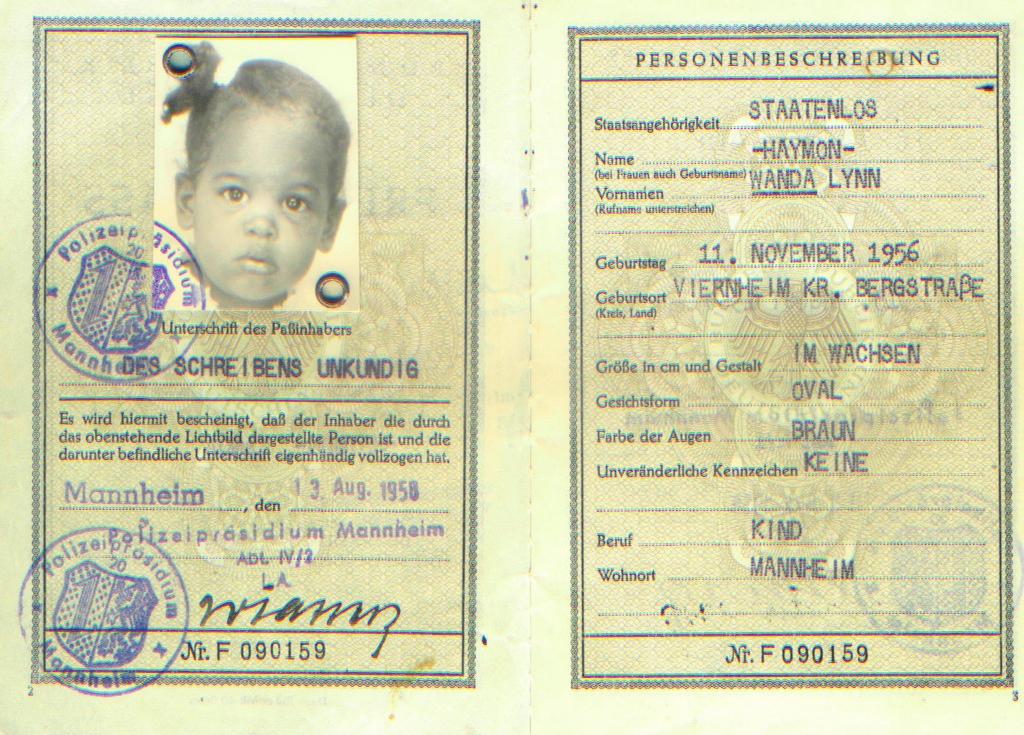
Rosemarie Peña’s passport. Sources: Black German Cultural Society, Wikipedia, Rutgers University profile of historian Rosemarie Peña, Transatlantic adoption & “brown babies”
1953
Refugee Relief Act

President Dwight D. Eisenhower in the Oval Office. ENHS Photo Congress passes a law that creates visas for orphans. Sec. 5(a) of the Refugee Relief Act states “Not to exceed four thousand special nonquota immigrant visas may be issued to eligible orphans as defined in this act who are under ten years of age at the time the visa is issued: Provided, That not more than two such special nonquota immigrant visas may be issued to eligible orphans adopted or to be adopted by any one United States citizen and spouse, unless necessary to prevent the separation of brothers and sisters.”
President Dwight D. Eisenhower signed the act on August 7, 1953.
Sources: Wikipedia, U.S. Library of Congress
1955
Harry and Bertha Holt adopt 8 Korean children
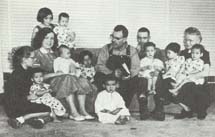
Harry and Bertha Holt with their children. Photo from Adoption History Project page. Source: Adoption History Project, To Save the Children of Korea by Arissa Oh.
1956
Holt Adoption Program

Harry and Bertha Holt with two Korean adoptees. Harry Holt begins the Holt Adoption Program with David Kim in 1956.
Sources: Holt International,
1957
First chartered plane delivering Korean children to the U.S.
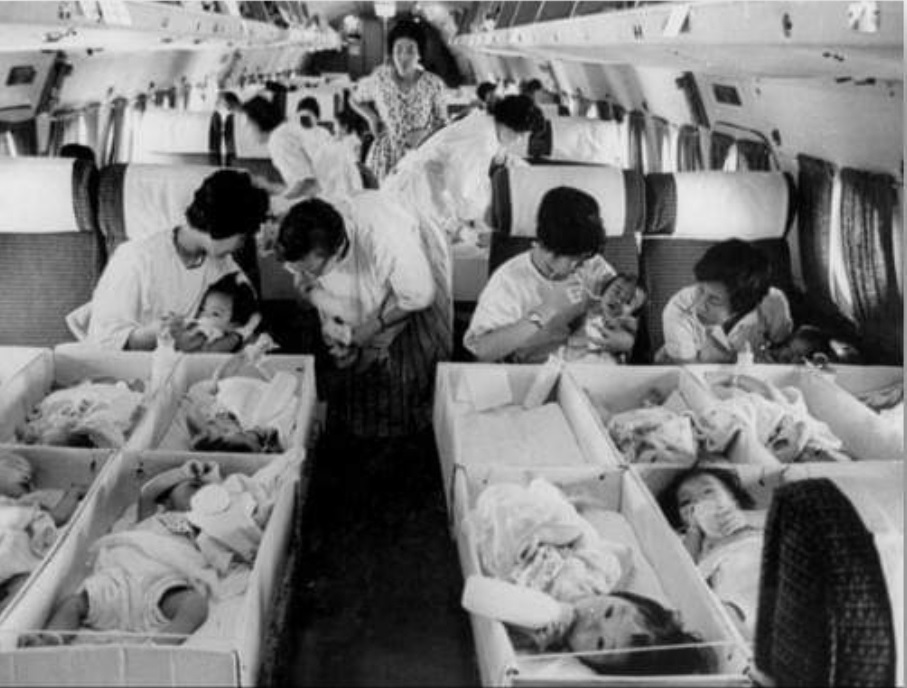
This undated photo shows the inside of a chartered plane en route for the US carrying babies to be adopted by families there. (Ministry of the Interior and Safety) The Korean Republic newspaper (now Korean Herald) reported over 400 Korean children had been sent to the U.S. by October 31, 1957.
Sources: The Korean Herald,
1970s
Colombian adoptions begin

Image by Andres Virviescas Through the use of private baby homes, children were “abandoned” and sent out of the country in private adoptions facilitated by the Colombian Institute of Family Welfare.
Sources: Collin Kawan-Hemler,
1975
Operation Babylift

A flight evacuating Holt children from Da Nang arrives in Saigon in late March 1975. From the Holt website. During the Vietnam war, President Gerald Ford authorized the evacuation of Vietnamese children to the U.S. The airlifts were framed as an act of rescue, although the crash of one of the evacuation planes killing 138 people (including 78 children) and the discovery that some of the childrens’ parents did not consent to their child’s evacuation caused criticism of the operation.
Sources: Wikipedia, The Best Possible Immigrants by Rachel Rains Winslow, Reuters.
1990-2004
Romanian adoption
Due to pro-natal and anti-abortion laws in the country by former leader Nicolae Ceausescu, orphanages in Romania swelled with children placed by families who were unable to care for them. Media reports of children experiencing extreme deprivation in the orphanages and a law in 1990 allowing for international adoption led to a rush of North Americans and Europeans adopting Romanian children. By the time the country closed its intercountry adoption program in 2004 an estimated 30,000 children had been sent for adoption.
Sources: Romania: For Export Only by Roelie Post, Wikipedia, RadioFree Europe, Adoption in Romania: Historical Perspectives and Recent Statistics by Popescu, Muntean & Juffer (2019)
1991-2013
Russian adoption
Russia opened its doors to international adoption in 1980s and more broadly allowed adoptions starting in 1991. Russian adoption was a popular source for children in the U.S. but by 2013 the country had banned adoption by U.S. citizens due to the Magnitsky Act, seen as retaliation for U.S. sanctions to Russia for human rights violations. Although intercountry adoptions ended practically after the Russian invasion into Ukraine in 2022, the 2024 ban on adoption to countries in which gender-affirming care is legal firmly closed intercountrey adoption.
Sources: National Public Radio, Wikipedia, Russian Federation: Adoption of Russian Children by Foreigners report (2001).
1992
China opens up for international adoption
1993
The Hague Convention on Protection of Children and Co-operation in Respect of Intercountry Adoption (also called The Hague Convention)
Developed by the Hague Convention on Private International Law, the Hague Convention is an international convention aimed at protecting children from international trafficking, abduction, and illicit adoption.
The convention was drafted May 29, 1993 and went into effect in May 1995.
Sources: Hague Convention website, Wikipedia.
1995
 Transnational /Transcultural Adoption Project